
The patchbay is a piece of equipment often misunderstood, especially by guitarists and bassists looking to optimize their pedalboard.
In this article, we’ll take a look at its benefits, its different versions and how it can improve your setup.

Patchbay studio vs patchbay for pedalboard
Before going any further, it’s important to understand the difference between two types of patchbays:
- The studio patchbay, used in recording studios
- The pedalboard patchbay, designed to centralize effect pedal connections
The studio patchbay: a centralized management interface
If you’ve ever visited a recording studio, you’ve probably noticed a panel full of jack connectors linked by small cables. It’s a studio patchbay.
What does it do? 👉 To simplify connections between the various devices (compressors, preamps, 19′ effects).
These devices are often mounted in cabinets, making their rear inputs and outputs difficult to access. The patchbay allows these connections to be moved to the front panel, making them accessible and facilitating connections.

The pedalboard patchbay: a connection interface
A pedalboard patchbay, which we should rather call a Connection Interface based on the principle of a Studio Patchbay, works on the same principle 👉 centralizing all connections in one place.
Let’s take a concrete example:
– Without a patchbay: you plug your guitar into the first pedal, then another cable connects the last pedal to your amp, and you have to turn your pedalboard upside down to connect the power supply.
– With a patchbay: all these connections are made in the same place, avoiding connection errors and complicated handling.
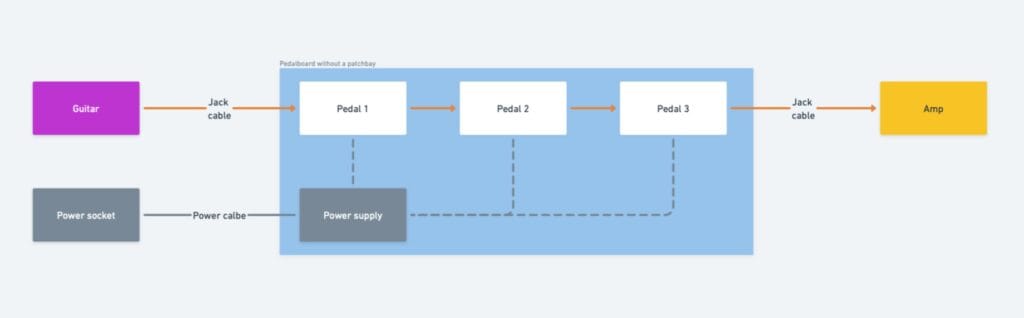
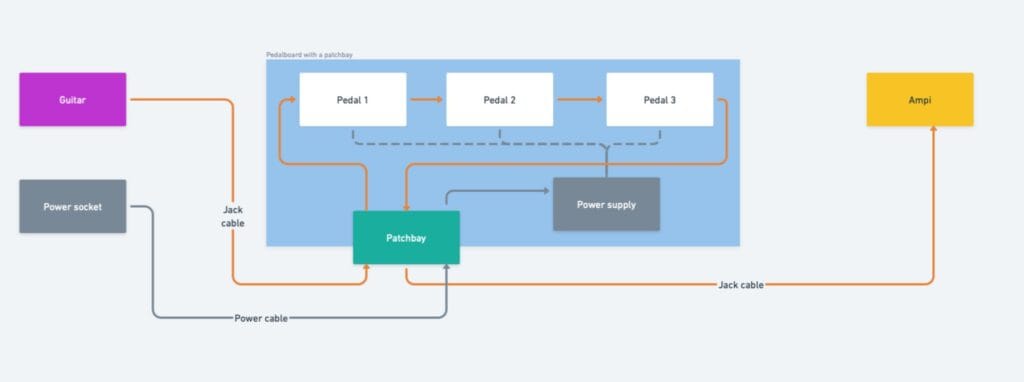
A patchbay for all signal types
A patchbay is not limited to audio connections. It can accommodate different types of signal:
- Audio (jack, XLR, etc.)
- Electrical (IEC or PowerCON type plug)
- Digital (USB, MIDI, etc.)
The different pedalboard patchbay formats
There are two main pedalboard patchbay formats:
1. Patchbays in box format
Some manufacturers offer patchbays in the form of pre-configured boxes. These models are practical, but often limit the available inputs/outputs to built-in options.

2. Modular patchbays in plate format
Modular patchbays, like those from rhuitsept, allow you to adapt the connections to your needs and make them evolve.
For example, if you want to replace a jack input with an XLR input, all you have to do is change the connector without modifying the whole patchbay. This flexibility makes it an ideal solution for musicians who evolve their equipment over time.

Why use a patchbay for your pedalboard?
In a few words, a pedalboard patchbay allows you to:
✅ Centralize your pedalboard’s inputs and outputs
✅ Simplify connections to save time
✅ Make your setup more reliable and reduce the risk of bad contacts
Whether you’re a studio musician or a live guitarist, a patchbay is an essential tool for optimizing your setup. If you want a well-organized, high-performance pedalboard, it’s a must-have!


 EN
EN  FR
FR